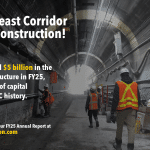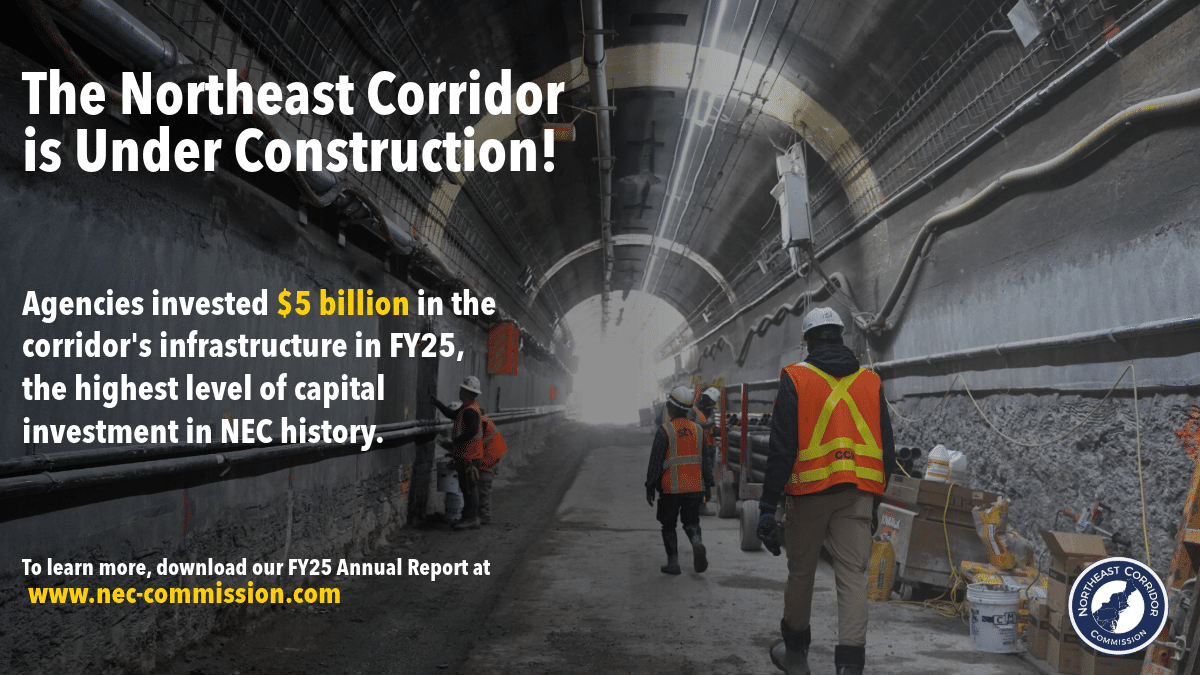
If it feels like the Northeast Corridor (NEC) is under construction everywhere you look, that’s because for the first time in generations, it is–and that’s a good thing! With almost 90 active construction projects and dozens of projects advancing through project development and design phases, Amtrak, Northeast states, and commuter agencies invested nearly $5 billion in NEC infrastructure last year, a new record. More details on this progress are available in the recently released FY25 Northeast Corridor Annual Report. Investment levels have been rising each year since the passage of the Infrastructure Investment and Jobs Act (IIJA) in 2021, and corridor stakeholders have been aggressively working to reverse the challenging operating conditions created by decades of chronic under-investment and “life support” funding for the corridor.
Projects under construction promise a better future for the nearly 700,000 riders—commuters, students, and business and leisure travelers—who depend on the corridor each day. These include Portal North Bridge—which is nearing completion on time and on budget—Penn Station Access, the Hudson Tunnel Project, Connecticut River Bridge replacement, Walk Bridge replacement, East River Tunnel Rehabilitation, and 30th Street Station Redevelopment. In addition, agencies are investing heavily in foundational capital renewal work, rebuilding the NEC’s rails, signals, electric traction systems, and undergrade bridges that support safe and reliable service.
Ramping up to this level of investment after decades of limited and uncertain funding wasn’t as simple as flipping a switch. Amtrak, for example, had to hire and train thousands of new employees and coordinate complex procurements, partnerships, and agreements. Without steady funding from IIJA, this progress would not have been possible.
Perhaps not surprisingly, increased ridership and service demand occurring alongside this unprecedented amount of construction has been contributing to some challenges, including worsening on-time performance. About 10 percent of all NEC trains were delayed or canceled in FY25. As usual, the top cause of delay was infrastructure—a combination of infrastructure failures and delays due to outages and programmed work. Mechanical delays were also up last year due to aging equipment. Learn more about these service trends in the FY25 NEC Annual Report.
The NEC is being rebuilt after too long a period of neglect. This process will not be easy or quick. It will take decades, but consistent funding and hard work can restore a great railway, one that is better, faster, and more reliable than anything this nation has ever seen.
Mitch Warren is the Executive Director of the Northeast Corridor Commission. Learn more at www.nec-commission.com