The Northeast Corridor (NEC) is an integral part of the region’s transportation network, relieving pressure on northeastern highways and airports, which are among the most congested in the nation. In fact, four of the ten most congested highways in the United States are in the Northeast, and accommodating the current volume of NEC riders in the air would require a 54% increase in flights, far exceeding available air network capacity. Railroads work together with the area’s airports to keep people moving efficiently and to provide travelers with flexible, interconnected options for reaching destinations near and far.
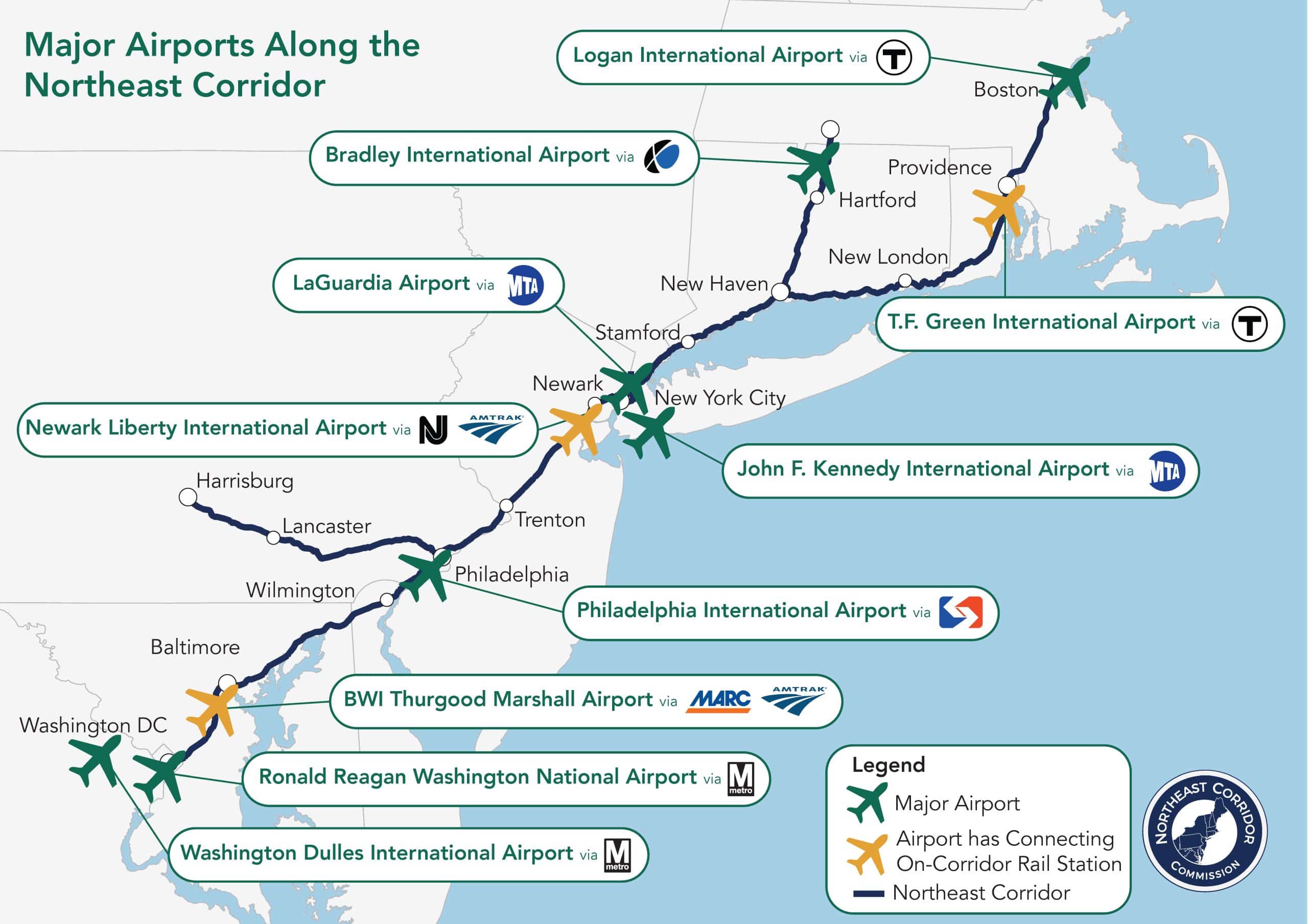
The NEC has been connecting riders to the region’s airports for over 40 years. Three NEC stations connect directly to major international airports: Newark Liberty Airport Station (accessible via Amtrak or NJ TRANSIT), BWI Marshall Airport Station (accessible via Amtrak or MARC), and T.F. Green International Airport (accessible via MBTA).
- Opened in 1980, BWI Airport Station was the first intercity rail station in the United States built to connect with an airport. Today, free shuttle buses run every 6-8 minutes and connect the station to each of BWI Airport’s terminals. In FY24 alone, 1.4 million passengers used BWI Airport Station during their travels.
- In 2001, Newark Liberty International Airport Station became the second airport station on the NEC. Through the AirTrain Newark monorail system, the station offers passengers direct access to each terminal. 2.9 million riders passed through Newark Airport Station in FY24, making it an invaluable asset for multimodal travel in the region.
- MBTA began service to a new station at T.F. Green Airport in 2010, directly connecting the airport to Providence, RI, and Boston, MA via the Providence/Stoughton Line. Nearly 71,000 passengers took the MBTA to T.F. Green in FY24.
There are even more train-to-plane options via rail or bus transfers: the five additional major airports along the NEC are just one transfer away from their closest city’s Amtrak station. This interconnected network ensures that whether you’re driving, hopping on a train, or catching a flight, your journey is part of a system designed to keep people moving.